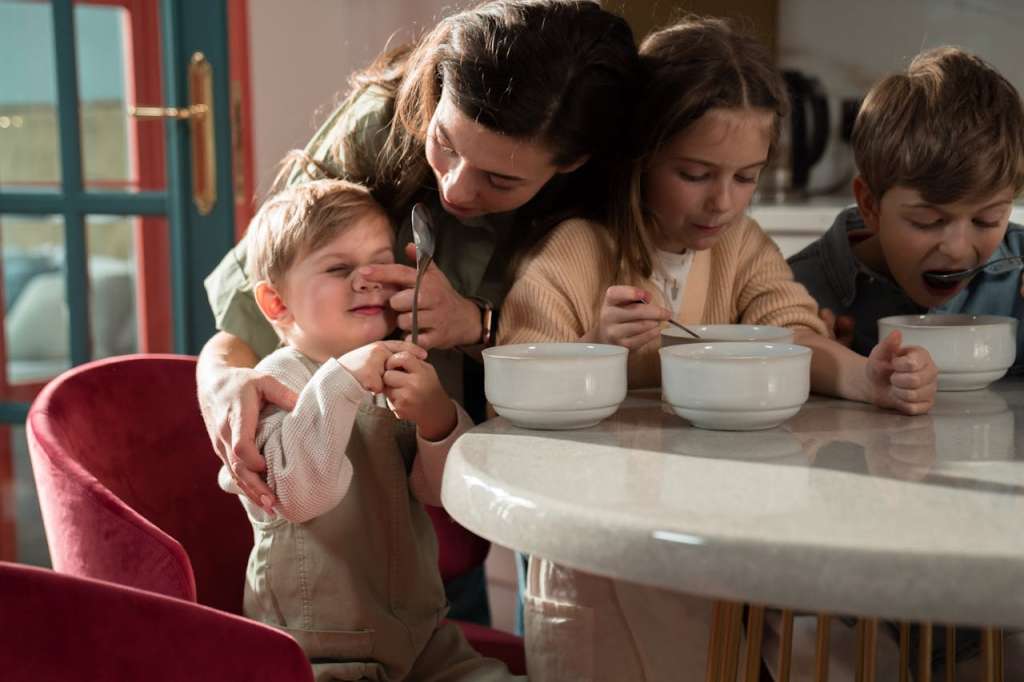
For many families, the moment to sit down at the table is not a time for bonding, but the beginning of a war. The scene is all too familiar: the child pushes the plate away, turns to the other side, maybe even cries, while you desperately try to convince him to try at least something that isn't bread or pasta.
In those moments, we often use that well-intentioned phrase: "Come on, just one bite, see how delicious it is!"„
But have you ever stopped to consider that for many children, that one bite means climbing a mountain?
While eating is an automated process for us adults, for children it is the most complex sensory task of their day. It is the only human activity that requires the simultaneous work of all seven sensory systems.
To understand why a child refuses certain foods, we must look at the process through the lens of his senses, because eating does not begin in the mouth, but much earlier.
1. Type: First Line of Defense (Security)
Even before food reaches the face, the eyes send a signal to the brain. The child assesses color, shape, and texture. For many children, even a small change (for example, a darker spot on a banana or a different brand of pasta) can signal danger. If the appearance is not 100% consistent with what the brain knows as safe, the defense mechanism is immediately activated.
2. Smell: Direct connection to memory and emotions
Smell is the only sense that travels directly to the amygdala (the emotion center) and the hippocampus (the memory center). This is why a certain smell can immediately make a child feel nauseous or afraid, even if they have never tasted the food. If the kitchen smells of spices that are too intense, a child's nervous system can go into a state of alarm before they even sit down at the table.
3. Touch (Tactile Sense): From Hands to Tongue
This is perhaps the most critical part. The sense of touch tells us whether food is wet, dry, sticky, hard, or soft.
In the hands: If a child doesn't want to touch food with their fingers, they're unlikely to put it in their mouth either. The lips and tongue are much more sensitive than the fingertips.
In the mouth: This is where the brain has to process a huge amount of information. Does the food break down evenly? Are there any „hidden“ pieces (like onion bits in the sauce)? For many children, these textures can trigger feelings of physical pain or panic.
4. Hearing: The sound insulation of chewing
Why do many children prefer chips or crackers? It's because they are predictable, meaning they always have the same properties: taste, smell, texture, crunching sound. On the other hand, soft fruits or vegetables don't produce a clear sound, which is disorienting for some children. Also, the sound of chewing in one's own head can be so loud that the child feels overwhelmed by the noise.
5. Taste: The Five Dimensions of Enjoyment
Taste comes at the very end. The brain needs to recognize sweet, salty, sour, and bitter, but if the previous senses have already sent a negative signal, the food won't even get a chance to be judged as "tasty.".
6. Proprioception and the Vestibular System: The Foundation of Everything
These are the "hidden" senses, but although they are classified as such and we do not learn about them in school, in sensory therapy they are considered primary sensory systems that enable the rest to function smoothly.
The vestibular system tells us where our head is in space and whether we are balanced. If a child sits in a chair with their legs dangling in the air, their brain is using too much energy just to keep from falling.
Proprioception helps a child know how hard to bite and how to move their tongue to move food from side to side. Without a stable body and good muscle awareness, chewing becomes a choking hazard rather than an enjoyment.
When we ask for „just one bite,“ we are actually asking the child to coordinate all of these brain signals at once. If one of these systems „reports“ an error or danger, the child’s brain does not see the food as a tasty meal, but as a direct threat, which activates the „fight or flight“ state.
Therefore, the resistance you see at the table is not a manifestation of bad behavior or disobedience, but a biological response of the brain trying to protect itself from something it perceives as dangerous.
Is my child just picky or does he have a real eating problem?
Very often these two terms are confused, but the difference between them is essential to how we approach solving the problem.
1. Picky eater
Picky eating is often a transitional phase. These children have a reduced food repertoire, but are still within the limits of functional eating.
Number of foods: They eat at least 30 different foods.
Food loss: If they stop eating a certain food because they get bored, after a break of a few weeks they usually accept it again.
Tolerance: They can tolerate new foods on their plate, even if they don't eat them (they can see or smell them without fear or defensiveness).
Socialization: They usually eat at least one food item from what the rest of the family is currently eating.
2. Problem eater
Here we are already talking about children where the sensory system or oral motor skills create a serious barrier.
Number of foods: They eat fewer than 20 foods (often only 5 to 10).
Permanent food loss: If they stop eating a certain food, it disappears from their menu forever. Even after a break, they don't go back to it.
Sensory Panic: New food on the plate causes extreme stress, crying, and even urges to vomit just from seeing or smelling it.
Rituals: They often only accept food from one specific brand or packaging (e.g. they only eat one type of biscuit, in a specific box).
Isolation: They almost never eat the same food as the rest of the family; a separate, specific meal must always be prepared for them.
Why is this difference important?
If you tell a problem eater, „You will eat when you are hungry,“ it will not happen. These children will starve themselves to the point of dehydration or weight loss because their fear of food is greater than the feeling of hunger. For them, hunger is not a motivator, but an additional stressor.
Forbidden Zone: Why does pressure turn off appetite?
When a child refuses to eat, our natural reaction as parents is fear. We fear that he will remain hungry, that he will not develop properly, or that we are failing in our role. That fear leads us to use pressure, blackmail, or begging.
Here's what happens in a child's brain when they feel pressure:
The brain activates the sympathetic nervous system (an alarm state). In this mode, the body secretes adrenaline and cortisol. These hormones have one primary task: to shut down the digestive system in order to free up and redirect energy to the systems responsible for survival. It is biologically impossible to feel hungry or enjoy food while the brain is trying to survive an attack. The pressure literally tells the stomach: „Now is not the time to eat, but time to run away!“.
To understand exactly why stress is counterproductive, we need to look at how the autonomic nervous system works. It is divided into two main parts that work like a balance: the Sympathetic (throttle) and the Parasympathetic (brake/rest).
1. "Fight or Flight" (Fight or Flight) – Sympathetic system
When a child is pressured („Eat this right now!“, „Don’t get up from the table!“, „Why are you crying, it’s nothing serious!“), their brain registers this as high stress. At that moment, the amygdala (the alarm in the brain) sends a danger signal.
Adrenaline and cortisol surge: These hormones prepare the body for survival. The heart beats faster, breathing becomes shallow, and muscles tense.
Digestive shutdown: Since the body needs all its energy for „fight or flight,“ it makes an instinctive decision: the digestive system temporarily shuts down. Blood is diverted from the stomach and goes to the extremities (arms and legs).
Result: The saliva in the mouth dries up (making chewing and swallowing physically difficult and uncomfortable), and the appetite disappears completely. The child literally does not feel hungry, even if his stomach is empty.
2. Rest and Digest – Parasympathetic system
The „rest and digest“ state is the opposite of „fight and flight.“ In order for a child to eat, their nervous system must be in this state. The parasympathetic nervous system is responsible for salivation, bowel movements, and feelings of hunger.
This system only works when the child feels safe, relaxed, and pressure-free. If you increase the pressure even slightly, the scales immediately shift to sympathetic and the eating process stops.
The vicious circle of stress
When a parent insists on "just one bite," they unconsciously push the child deeper into a state of alarm.
The child feels afraid of food/texture.
The parent presses.
The adrenaline is rising.
The appetite is turned off.
The child refuses even more strongly (because he is physically nauseous or finds it difficult to swallow).
The parent becomes more frustrated.
You will often hear advice: „Leave him alone, when he gets hungry he will eat anything.“ This may work for typical eaters, but for problem eaters this is dangerous.
For them, hunger is just an additional stressor that further activates the sympathetic system. Instead of motivating them to eat, hunger makes them even more irritable and less able to cope with the difficult sensory task of eating.
Key tip from CEDUZ: The first step to a successful meal is not food, but safety. Only when a child feels safe and comfortable, and when the alarm in his brain has been turned off, can his digestive system be turned back on.
Phrases you should ditch (and why):
„"Just one bite and it's done!"“
Why it's problematic: For a child, that bite is too big a risk. This phrase breaks trust because the child knows that after that bite, new pressure often follows.
„"See your brother eating well, be like him."“
Why it's problematic: It creates feelings of shame and inadequacy. Eating becomes a social competition rather than an internal need.
„"If you don't eat the broccoli, there's no cartoon/dessert."“
Why it's problematic: This is blackmail. This just reinforces to the child that broccoli is really bad and is just a punishment that must be endured to get the reward. This increases the aversion to healthy foods.
„"It's not scary, try it, it's delicious!"“
Why it's problematic: This denies your child's sensory world. If the smell is too strong for them, you're telling them not to trust their own senses.
Stairway to a successful meal: the 6 levels of interaction
This hierarchical approach is revolutionary because it breaks the myth that eating consists of just one step: "put in mouth and swallow.".
According to this approach, there are many more steps in the feeding process, grouped into 6 main levels. This helps parents understand that if a child has just looked at the food or touched it with their fingertip, they have already climbed several steps up, thus getting closer to the main goal.
Think of these levels as a staircase on which a child must feel safe before moving on to the next.
Level 1: Visual Tolerance (Being in the same room as food)
This is the first and easiest step. The child learns to tolerate food without panic.
The food is on the table (not on his plate).
The food is in front of him (on his plate, but he doesn't touch it).
Success is: When the child stops crying or pulling away when they see the scary vegetable.
Level 2: Touchless interaction
The child begins to manipulate food using tools.
Use a fork or spoon to move food around the plate.
Helps in the kitchen (e.g. pours chopped carrots into the pot).
Success is: When the child gets involved in preparing the food without fear of being forced to try it.
Level 3: Smell (Olfactory Processing)
Smell is often the strongest trigger for nausea.
The child tolerates the aroma in the kitchen.
The child raises the food close to his nose to smell it.
Success is: When the smell of a cooked meal no longer causes aversion.
Level 4: Touch (Tactile Desensitization)
This is where the real getting to know each other begins. This level involves touching different parts of the body:
Touching with the fingertips, then with the whole palm.
Touching food with the nose, cheeks, chin.
Touching food with the lips and tip of the tongue.
Success is: When the child "kisses" the food or allows it to touch his lips.
Level 5: Taste (Interaction in the mouth)
Tasting is the penultimate step, not the first!
The child puts the food in his mouth, but immediately takes it out.
The child bites the food, holds it briefly in his mouth, and spits it out onto a "learning napkin.".
The child chews the food partially.
Success is: Any retention of food in the mouth, even if it is not swallowed.
Level 6: Eating (Complete process)
This is the final step where the child finally chews and swallows food with enjoyment.
Why is this hierarchy important to you?
As parents, we often focus only on Level 6. When a child swallows, we are happy. When they spit out the food (Level 5), we are disappointed.
This approach teaches us the opposite: If your child just touched broccoli with their finger today for the first time, that's not a defeat. That's a Level 4 victory. It means their brain has stopped seeing broccoli as an enemy and started seeing it as material for exploration.
Without passing the previous 5 steps, the child will never reach the last one in a stable and long-term way.
CEDUZ Practical advice for home
The Food Chaining method is one of the most powerful strategies. Instead of offering your child a completely new and „scary“ food, you create a bridge from a food they already like to the food you want to introduce.
The key is in the small, almost invisible changes. The change can be in color, shape, texture, or taste, but never all four at once.
How to make Food Chaining at home? (Step by step)
You can apply this pattern to any food item. The goal is for each new link in the chain to be just 10-20% different from the previous one.
Step 1: Mapping "Safe Food"„
First, determine your child's favorite food. Let's take a simple potato (baked or fried) as an example.
Why does he like it? Probably because of its yellow color, crunchy texture, and predictable salty taste.
Step 2: Change the shape (Same food, different appearance)
Don't change the food, just the way it's presented.
If he eats French fries (sticks), cut the potatoes into rounds or cubes.
Goal: For the brain to learn that although the appearance is different, the essence is safe.
Step 3: Change in texture or color (Similar food)
Here we introduce the first new food that shares similar characteristics with the safe one.
Example: From baked potatoes we switch to baked chickpeas.
Connection: Chickpeas when roasted are crunchy and have a similar color to potatoes, but the texture is different.
Step 4: Changing the Taste (Introducing Spices)
We use a food that the child has already accepted and add new sensory information.
We add a little turmeric to the roasted chickpeas to enhance the yellow color, or a little oregano.
Goal: Acceptance of new scents over an already accepted texture.
Step 5: Final Goal (Completely New Food)
Now that the child has accepted chickpeas and different spices, we can introduce something more challenging, like cooked lentils or beans, because now the child is used to legumes.
Examples of Food Chaining (from your grocery list):
Here are three specific paths you can try:
Starting Point: Plain Yogurt
Small change: Greek Yogurt (thicker)
Big change: Greek yogurt with pureed blueberries
End goal: Greek yogurt with whole blueberries
Starting point: Boiled white chicken meat
Small change: Chicken with a little spice
Big change: Fried chicken
End goal: Roast chicken
Starting point: Crispy chips
Small change: Apple chips
Big change: Thinly baked zucchini rounds
Ultimate goal: Fresh cucumber
Golden rules for parents:
Be patient: Each link in the chain can take days or weeks. Don't rush to the next one if the child isn't 100% confident with the previous one.
Masking vs. Exposing: Don't hide the new food in the old. The goal of Food Chaining is for the child to consciously accept the change. If you lie to them, you will lose their trust and go back 5 steps.
Involve your child: Let them help "color" the food with turmeric or chop the zucchini. The more they participate in the change, the less they will fear it.
CEDUZ Nutri tip: How to introduce new flavors without stress?
Here are three rules for sensory cooking at home:
1. Use „sensory bridges“
If the child likes a certain color, use it!
Tip: If your child only accepts yellow foods (potatoes, pasta), add a little turmeric to the rice. The turmeric gives it its favorite color, but it also introduces a new, delicate flavor and anti-inflammatory benefits without changing the texture.
2. Texture is more important than taste
Most children refuse food because of how it feels in their mouth, not because of the taste.
Tip: If your child refuses „slimy“ textures (like cooked spinach or zucchini), try roasting them until they’re crispy. For example, make roasted Brussels sprouts with a little olive oil and salt. Crunchy is sensory safer for the brain than soft.
3. Exposure through play (no obligation to eat)
Instead of putting the meal in front of the child, involve them in a "science expedition.".
Tip: Take sunflower or pumpkin seeds and practice fine motor skills. Have your child transfer them from one container to another with their fingers or a spoon. Touching different surfaces desensitizes the hands, which is directly related to desensitization of the mouth.
Conclusion: From struggle for survival to shared enjoyment
Feeding is a learned skill, just like walking or talking. If your child struggles with this skill, it doesn't mean you're a failed parent, nor does it mean your child is "difficult." It simply means that his sensory system is currently experiencing food as a challenge, not a pleasure.
It's important to remember: the goal of a meal isn't just to provide calories, it's to build trust. Every time you take the pressure off, replace blackmail with curiosity, and allow your child to explore at their own pace, you're helping their brain relax.
At CEDUZ, we believe that the path to a full plate leads through understanding the child's sensory world. By applying this approach, we don't just teach the child to eat, but we teach them how their senses can become their allies at the table.
Don't let lunch remain a battlefield. With patience, the right strategies, and expert support, every step of the hierarchy is achievable.