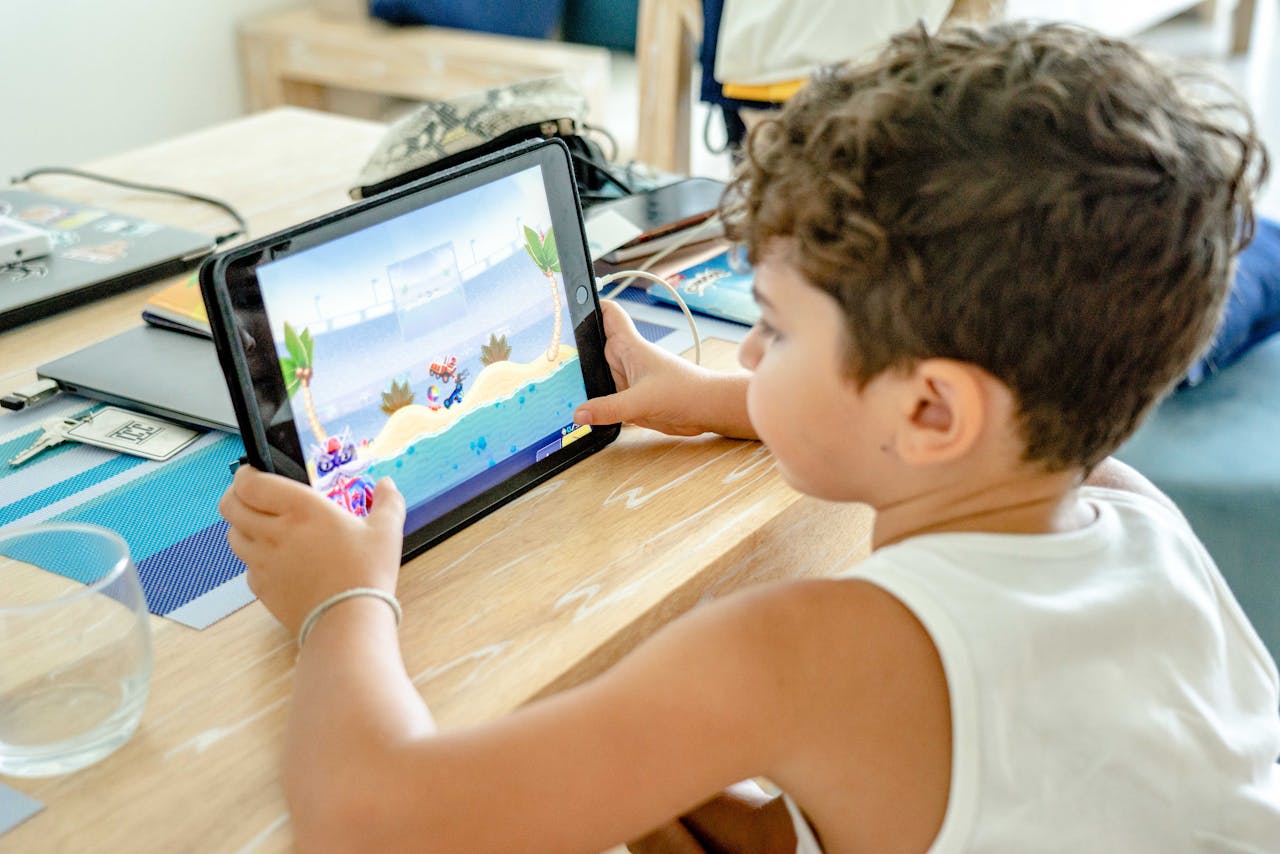
We often hear that screens are harmful, but rarely does anyone explain why. The key lies in the way a child's brain develops in the early years: it is programmed to learn through two-way interaction. But when a child looks at a screen, it is in a state of passive reception of information. The brain is bombarded with rapidly changing images, bright colors and artificial sounds that cause excessive secretion of dopamine (the pleasure hormone).
This creates two big problems:
Lazy speech center: Speech only develops when the child needs to communicate with another person who responds with emotion, gesture, and gaze, but the screen does not demand a response. The child's brain concludes that there is no need to try to produce a word, because the fun comes effortlessly. This leads to what we call "screenism" and a pronounced delay in speech.
Fragmented attention: Modern cartoons have fast frames (changing images every 2-3 seconds). The brain gets used to this pace. Later, when the child needs to focus on slow activities like stacking blocks, listening to a story, or having a conversation, his brain becomes anxious because the real world is too slow and boring compared to the screen.
Delay Mechanisms: How does the screen silence the child?
To speak, the brain needs social pragmatics, something that no app or cartoon can replace.
Here's what exactly is happening:
Serving and Returning: Language development relies on a tennis model: the child makes a sound or gesture (the serve), and the parent responds with a word or smile (the return), but the screen is an indifferent wall that only offers information and never responds to the child's attempts at contact. Without this feedback loop, the brain pathways responsible for language are not sufficiently activated.
Replacing symbolic learning with 2D imitation: Young children learn about the world in three dimensions. When a child sees an apple on a screen, it is just a two-dimensional light signal. To learn what an apple is, the brain must touch, taste, smell, and feel it. Because screens disconnect the body from learning, words remain empty concepts in memory, without any substantial sensory meaning or use in reality.
Loss of sound discrimination: The constant background noise from the screen (even if the child is not looking directly at it) creates aural chaos, and the child's brain does not yet know how to filter sounds. When the screen is constantly running, the child stops distinguishing the fine nuances in human speech and its phonemes, which are the first step towards understanding and correct pronunciation.
Mechanisms of fragmented attention: The brain in the fast lane
Children's attention is built like a muscle through slow, repetitive activities, but screens do the opposite: they train the brain to be hyperactive, and attention to be grasping, as opposed to consciously directed.
Erosion of sustained attention: In the real world, for a child to stack blocks or draw a circle requires effort and time, but in the digital world the reward is immediate. Every few seconds there is a change of scene, a new sound, or a burst of color. This teaches the child’s brain that news comes quickly and effortlessly. When a child is faced with a real-world task that requires waiting or effort, their brain enters a state of abstinence, that is, it becomes bored and immediately seeks new stimulation.
Impaired working memory: For a child to follow directions and sequence actions, they need functional working memory. The rapid frames of screens overload this system. The brain is so busy processing new visual information that it has no room to store previous information. The result is a child who appears not to be listening, when in fact their brain is too tired from the digital noise to process a simple command.
Artificial maintenance of attention: According to the source of attention, there are two types:
External (Exogenous): When something strong and loud forces us to look at it (screens).
Internal (Endogenous): When we consciously decide to focus on something (reading a book, playing). Screens only develop external attention. A child may seem hypnotized and calm while watching cartoons, but this is not true focus, but rather passive fascination. When the screen is turned off, the child has not developed an internal mechanism to direct his or her attention on his or her own, so he or she becomes irritable and disoriented.
Designed Addiction: How Profit Shapes Children's Brains?
The dark side of the children's industry, which parents rarely see as such, but is key to understanding the problem, is not an accident but a deliberate engineering. While we think our child is watching an educational cartoon, teams of child psychologists, data experts, and neuroscientists are working on how to make that content as difficult to turn off as possible, that is, addictive content.
Here's how big corporations are hijacking children's attention:
Supernormal Stimuli Theory: Corporations use colors that don't exist in nature: neon, oversaturated hues that artificially excite a child's visual system. Sounds are compressed and tuned to frequencies that keep the brain constantly on high alert. The real world (trees, sky, toys) looks gray and uninteresting in comparison. The goal is clear: to make the screen-free world boring.
Fast Frame Engineering (The 2-Second Rule): Modern cartoons have an average frame change every 2 to 3 seconds. This activates the orientation reflex, which is a primitive survival mechanism that forces us to look up when something changes in the environment. By forcing the frame change, the child is physiologically unable to look away. He is not paying attention because he is interested, but because his brain is stuck in a cycle of constant switching of attention.
Algorithms and „Auto-play“ as a trap: Platforms like YouTube Kids and Netflix are designed to eliminate the moment of decision. The auto-play feature takes advantage of the fact that children’s prefrontal cortex (responsible for self-control) is not developed. If the video just continues, the child will not say stop. For corporations, every extra minute is profit, while for a child it is another minute in which their brain is robbed of quality time that would stimulate their development.
False education as a marketing ploy: Many apps and cartoons are branded as educational just to appease the parent's conscience. The science is clear: a child under 3 years old cannot learn a language from a one-way 2D source. That the child is learning English is just an illusion, in fact, cartoons create a poor and mechanical vocabulary without functional use, because repeating words from a screen is not communication, but just an empty echo that takes up space intended for the development of the mother tongue and real social connection. The label "educational content" is just a tool for selling subscriptions and toys related to the characters, while the child's real development is sacrificed for the quarterly financial report of some faceless corporation.
The message is harsh but true: On the screen, your child is not a user, but a product, and their attention is the currency traded by large corporations.
The Cocomelon Case: Laboratory Engineering in the Spotlight
The case of Cocomelon is perhaps the best example of how science can be used against the natural development of a child. These are not just cartoons, but a software-engineered digital drug. Unlike traditional cartoons that rely on telling an educational story, Cocomelon relies on real-time neurological tests.
The Distractor Test: Their research techniques involve focus groups where children are placed in front of a screen playing Cocomelon, while in the corner of the room is another small screen called a distractor. This is perhaps the most controversial part of the development process of modern children's content. The distractor test is a crude, laboratory method whose sole purpose is to eliminate every second of the video in which a child might wander or look away.
Here's what their methodology for maximizing children's attention retention looks like:
A child (often only 18-24 months old) sits on a chair in front of a large screen on which a working version of the cartoon is playing.
To the side of the child, on another smaller screen or in the corner of the room, is placed a so-called distractor – a device that emits bright lights at irregular intervals, displays flashing chessboards, or makes sudden sounds.
High-precision cameras track the child's eye movements. Researchers measure how many times and at what exact moment the child looks away from the cartoon to see what's happening on the side screen.
If even 101% of the children look at the distractor during a scene, that scene is considered a failure. It goes back to the animators with the order: "Make this faster, add more color, speed up the music, add a burst of sounds.".
When your child seems hypnotized by watching the content of Cocomelon and doesn't listen to you when you call out to him, it's not because the cartoon is very interesting, but because the animation was designed in a laboratory to be stronger than his biological defense system. And, when the child gets used to this level of stimulation, his arousal threshold rises to an extremely high level. Anything below that level (such as a parent's voice, playing with blocks, or looking at a picture book) becomes invisible to his brain. This causes a trance state while the child looks at the screen. When you turn off the cartoon, the level of dopamine in the brain drops sharply, resulting in extreme outbursts of rage. The child is not acting like this because the story has been interrupted, but because his nervous system is experiencing a withdrawal crisis.
Cocomelon doesn't teach your child colors, letters, numbers, or English, but rather teaches their brain to be an addict whose attention is only worth extreme stimulation.
Official recommendations from CEDUZ: How much is too much?
CEDUZ has set these limits in order to protect the neurological development and physical health of children:
Children under 3 years old: ZERO screen exposure. We recommend that children at this age do not spend any time in front of any screens (TV, phone, tablet). The only exception is video chats with close relatives (grandparents), but even that should be brief and with a parent present.
Children from 3 to 5 years old: Maximum 1 hour per day. But we explicitly emphasize: Less is better. This one hour should not be all at once, but divided into short periods, and always with age-appropriate content and with the presence of a parent who will explain what is happening on the screen.
Sleep and screens: We recommend not using screens for at least an hour before bedtime, as blue light blocks melatonin and disrupts sleep quality, which further impairs attention and speech the next day.
Screen time for children under 2 years old is lost time for:
Physical activity that is crucial for motor development.
Face-to-face interaction is the only way to learn a language.
Quality sleep is essential for brain development.
A message to parents: These recommendations are not here to create guilt, but to serve as a guide. Every minute spent in active play instead of in front of a screen is a direct investment in your child's capacity to focus and communicate.
What next? Practical steps for home
If you recognize some of these signs in your child, don't panic because a child's brain is extremely plastic and can be reset.
Here's how to get started:
Gradual reduction: If a child spends a lot of time in front of a screen, an abrupt interruption can cause a stormy crisis and enormous stress. Reduce the total time spent in front of a screen by 15 minutes each day, but the screen must be turned off during meals and at least 60 minutes before bedtime. Mealtime is a time for practicing oral motor skills and social communication, not for passive swallowing.
Replace digital distractions with sensory play: When you turn off the screen, your child’s brain craves stimulation. If you don’t offer them something interesting, they’ll be looking for their phone back. Engage them in activities with strong resistance and tactile feedback: kneading dough, playing with sand, carrying heavy objects, or walking like a bear. These proprioceptive exercises calm the nervous system more effectively than any cartoon.
Comment, Don't Ask Technique (for speech): Instead of asking the child "What is this?" (which creates pressure and a test situation), simply comment on what you or the child is doing. Instead of "Say dog," say "Here is the dog. The dog is running. Aww!" This is the live interaction model that the screen lacks and encourages the brain to connect the word with the action.
Introduce audible silence: Turn off the TV when no one is watching. Silence allows your child to hear your voice more clearly and begin to filter out sounds from the environment, which is the first step toward understanding speech.
Your presence and the most ordinary game of dice are more educational than the most expensive app in the world, because in those moments you are not only transmitting information, but also living energy, rhythm and emotion. Your child does not learn from dead pixels on the screen that only hypnotize him, but from the micro-expressions of your face, from the tone of your voice and from your gaze that confirms that he is seen and understood. No algorithm can replace the feeling of touch as you build a tower together, nor can it simulate the complex social exchange that occurs when a child looks you in the eye for approval. It is these shared moments that are the fuel that drives brain development and builds the foundation for speech, attention and emotional intelligence.
Reality in numbers: How much time do children spend in front of screens?
Although awareness of the harmful effects of screens has increased significantly, the reality on the ground looks like this:
Children under 3: Research shows that as many as 751% of children in this age group are exposed to screens daily. The average time is between 45 and 60 minutes, which is a direct violation of the zero exposure recommendations.
Children from 3 to 5 years old: Instead of the recommended maximum of 1 hour, statistics say that children in this category spend an average of 2.5 to 3 hours a day in front of a TV or tablet.
Weekends and holidays: This figure often doubles during weekends, reaching up to 5-6 hours per day.
Scientific studies that track the impact of these numbers on early development reveal a worrying correlation:
Speech delay: Every 30 minutes of additional screen time in the 6-24 month age group increases the risk of expressive speech delay by 49%.
Attention problems: Children who spent more than 2 hours in front of a screen before the age of 3 are 8 times more likely to develop symptoms of ADHD (attention deficit hyperactivity disorder) by the time they start school.
Sleep quality: As many as 301% of children who use screens before bed have difficulty falling asleep and more frequent nighttime awakenings, which is a direct consequence of melatonin being blocked by blue light.
Message: These statistics are not here to scare you, but to show you that "just a little cartoons" for young children is actually not a little for their brains, which are in intensive development.
CEDUZ Semaphore: Content Selection Guide
If you decide to allow your child (over 3 years old) a short amount of screen time, not all content has the same effect on their brain. Use this simple traffic light to make better choices:
RED LIGHT (Avoid):
Hyper-fast and sensory overloaded cartoons (e.g. Cocomelon, Little Baby Bum, Paw Patrol): Frames that change faster than 3 seconds, overly bright colors, and constant noise. If the frame changes every 1-5 seconds, the child's brain does not process the content, but only reacts to the changes. This is the main culprit for fragmented attention.
Unboxing videos: These videos are designed to induce addictive behavior and gluttony in children. They hack the reward center of the brain and create the illusion of constant anticipation and gratification without effort, leading to increased consumer greed and low frustration tolerance.
Content with aggressive music and shouting: Such cartoons overload a child's sensory system with a constant onslaught of high intensity, where dialogue is replaced by shrill voices, hysterical laughter, and synthetic sound effects.
Artificial color palette: Avoid cartoons with neon and oversaturated colors that don't exist in nature. They artificially raise the threshold of excitement and make the real world seem gray and uninteresting.
Characters with unnatural proportions and oversized eyes: Modern animation often uses characters with extremely large eyes and exaggerated, „rubbery“ facial expressions that do not exist in human nature. This is a conscious attempt to hack a child’s biological instinct to connect with faces, but in an exaggerated, artificial way that science calls supernormal stimulation. When a child gets used to such visually perfect and hyper-expressive characters, their brain begins to lose the ability to read the subtle, real emotions on the faces of their parents and peers. Real people seem uninteresting and static to them compared to these digital characters, which creates a serious barrier to the development of empathy and social intelligence.
Cartoons with scattered action: Content that does not have a clear narrative structure (beginning, plot, and end), but is instead a series of disconnected, short, and absurd situations. This format does not allow the brain to practice sequential thinking, which is the ability to understand that one action leads to another.
Interactive educational apps with instant rewards: Games where for every simple click or tap, the child receives an explosion of fireworks, stars, and triumphant sounds. While it may seem like the child is learning letters or colors, it is actually just training the brain for instant gratification.
YELLOW LIGHT (Be careful):
Educational apps: Although they practice letters and numbers, they are still 2D and do not replace physical manipulation of objects. Use them only in your presence.
Cartoons with a lot of talking but fast action: Even if there is good vocabulary, the speed of the action can hinder comprehension.
Digital picture books with too many effects: While reading is fine, many e-books have hidden animations and sounds on every page. Research shows that with such „enriched“ content, children focus on where to click to see an animation, rather than listening to the story and understanding the language.
„"Bibi's World" (Bibi and Bobi): Although it is a quality source of Macedonian vocabulary and excellent messages, visually this cartoon uses techniques of modern animation: disproportionate and exaggerated heads and eyes of the characters, intense color and relatively rapid change of frames. If you decide to use it for language enrichment, strictly limit the duration and always watch in your presence, while commenting on the content to slow down the effect on the screen.
GREEN LIGHT (Recommended – Slow Cinema):
Slow-paced cartoons (e.g. Winnie the Pooh, Peppa Pig, Pingu, Bully Bully, Kipper the Dog): Choose content where the action flows naturally. If a character goes to the garden to pick an apple, the child should see the whole process: walking, reaching, picking the apple. In „green“ cartoons, there are no sudden jumps where the character suddenly appears in another location. This helps the brain build a sense of time, space and cause-and-effect relationships, which is the basis for logical thinking. It is important that the frames last longer, the movements are natural, and the dialogues are clear and with pauses.
Clear speech with pauses for thought: Quality content has clean dialogue, without loud background music that drowns out speech. The most important element here is the pauses. When a character asks a question or says something, there is a few seconds of silence. That silence is the space where your child’s brain translates sound into meaning. This mimics real conversation and gives your child (even if they aren’t speaking) a chance to process what they’re hearing.
Calm and natural aesthetic: Instead of neon colors, these contents use natural tones, pastel colors and hand-drawn illustrations that are reminiscent of a picture book. The sounds are organic: real instruments, birds, rain or rustling leaves. Such an aesthetic does not overload the visual and auditory systems, but keeps the child in a state of calm focus, rather than in a state of hypnotized excitement.
Stories with moral and emotional weight: Instead of empty skits, "green" content offers simple but warm stories about friendship, helping, patience or solving small everyday problems. The characters show real emotions (sadness, joy, fear) in a calm manner and with an expressive tone proportional to real people (as opposed to the hyper-expressive characters of "red" cartoons), which helps the child develop social empathy and recognize those feelings in themselves and others.
Nature and animal documentaries: Real-world footage is an invaluable source of knowledge because it introduces a child to the natural colors, textures, and sounds of the planet without digital distortion. Unlike animations, here the movements are organic and unpredictable, which encourages a child to observe carefully and be patient. Watching a squirrel slowly gather hazelnuts or rain falling in the forest calms the nervous system and helps the brain build a realistic map of the world around it, while developing respect for the living world without artificial hyperstimulation.
Storytelling (Storytelling Videos and Audio Fairy Tales): Videos where someone reads a story and slowly turns the pages of a real book are perhaps the closest digital substitute for live interaction. This format keeps the focus on the language and the illustration itself, rather than aggressive special effects. Because the pace is dictated by a human voice that pauses, the child is given space to process the words and connect them to the image. This not only enriches vocabulary, but also cultivates a love of books as a subject, preparing the brain for later independent reading and longer concentration.
CEDUZ Nutri Tip: Food to Reset Attention
Did you know that excessive screen exposure depletes huge amounts of specific nutrients that the brain needs for focus? When we work to cut back on screens, nutrition is a great ally in calming hyperactivity.
Omega-3 fatty acids: The brain is mainly made up of fat. To repair our attention pathways, we need omega-3 fats, which have anti-inflammatory properties. Increase your intake of sardines, mackerel, and freshly ground flaxseed. These foods help improve communication between neurons.
Magnesium: Screens keep your child in a state of excitement. Magnesium helps with muscle and nerve relaxation. Offer your child pumpkin seeds, almonds, or spinach. This will help them transition more easily from the fast-paced digital world to a peaceful sleep.
Avoid the sugar rollercoaster: The combination of fast food and refined sugar is a recipe for a complete loss of control over your behavior. Instead of snacks and juices (even „healthy“ juices, orange or apple juice are full of refined sugar), offer blueberries, raspberries or blackberries. Their antioxidants protect the brain from oxidative stress caused by blue light.
The path to change doesn’t have to be perfect, but it does have to be conscious. By reducing screen time, nourishing your child’s brain, and replacing digital noise with your authentic warmth, you’re not just solving a momentary attention problem, you’re building a strong foundation for a lifetime. Every time you turn off your device, you’re actually turning on your child’s potential. We’re here to support you every step of the way, because at CEDUZ we believe that the most powerful technology for development is still human connection.